Scabies - the hidden parasite under your skin! How to detect it in time?
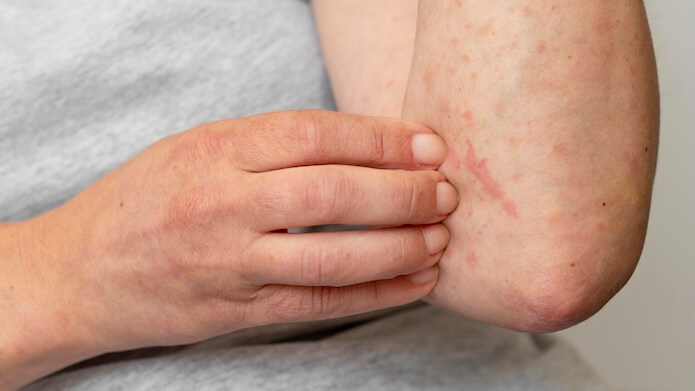
Scabies is a common skin disease caused by the scabies mite (Sarcoptes scabiei var. hominis). This disease is highly contagious, spreading through direct contact between individuals or through infected items such as bedding or clothing. Scabies mites cause intense itching and rashes as they burrow into the upper layers of the skin where they live and breed.
What is scabies?
Scabies is a common skin disease caused by the scabies mite (Sarcoptes scabiei var. hominis). This disease is contagious, spreading through direct contact between individuals or through infected items such as bedding or clothing. Scabies mites cause intense itching and rashes as they burrow into the upper layers of the skin where they live and breed. The World Health Organization (WHO) classifies scabies as a neglected tropical disease that mainly affects societies with poor hygiene and close living conditions. However, scabies can affect people all over the world, regardless of socioeconomic status or climate. It is important to note that scabies is not only a dermatological problem, but also a public health issue that, if ignored, can lead to epidemics. Treatment is essential to avoid complications and break the chain of infection, especially in high-incidence communities.
The causative agent of the disease
Scabies is caused by the scabies mite Sarcoptes scabiei var. hominis, which is a microscopic parasite belonging to the class Arachnida. These mites are about 0.2-0.4 mm in size and cannot be seen with the naked eye. They dig passages in the stratum corneum of the skin where they lay their eggs. Scabies mites are specially adapted to live on the surface of human skin and have a life cycle of about 10-14 days. This parasite is highly contagious, and infection often occurs through close skin-to-skin contact, such as between family members or sexual partners. On the other hand, scabies mites cannot survive for long outside of a human host, which somewhat limits their spread, but still requires careful caution in public places.
Epidemiology and prevalence statistics
Scabies prevalence statistics vary by region, affecting both developed and developing countries. WHO data show that scabies is particularly widespread in tropical and subtropical regions where social and economic barriers make access to health care difficult. Epidemiological studies show that scabies is more common in places with high population density and poor hygiene, such as dormitories, refugee camps and other places of public life. These factors make scabies a common problem that requires the attention of public health authorities.
Symptoms of scabies
Early symptoms
The early symptoms of scabies usually appear two to six weeks after the initial infection if a person is infected for the first time. However, in the case of repeated infections, symptoms may appear much sooner, within a few days, because the immune system is already sensitized to the parasite. Initial symptoms usually include intense itching that often becomes more pronounced at night. Itching is associated with an allergic reaction to the presence of the tick and its secretions. Early symptoms may also include itchy papules and small bumps on the skin that can become inflamed and lead to secondary bacterial infections if scratched vigorously. The itching and rashes usually start on the hands, wrists, fingers, and flat parts of the body such as elbows, knees, and abdomen.
Progressive symptoms
If scabies is not diagnosed and treated early, symptoms can progress and become more severe. In addition to increased itching, peeling of the affected skin areas is also possible, and a linear rash may appear, indicating the passageways the ticks have entered. These rashes are often reddish and may spread to other parts of the body. Progressive symptoms of scabies can also include sores and scabs on the skin from constant scratching. These areas are prone to secondary infections, such as impetigo, which can seriously complicate the patient's condition. More severe cases can develop Norwegian scabies, a type of scabies that usually affects people with weakened immune systems and causes thickened crusts and massive tick colonization.
Possible complications
Diagnostics
Diagnostic methods
Diagnosis of scabies is mainly based on clinical evaluation and patient history. Dermatologists and other health care professionals can use different diagnostic methods to confirm scabies. One of the most commonly used techniques is dermatoscopy, which allows you to enlarge and examine the skin surface in detail, identifying the passages of scabies or the mites themselves. Another method involves scarification and scraping of the skin, which are microscopically analyzed for ticks, their eggs or feces. In some cases, a needle biopsy may also be used to make a more accurate diagnosis. In addition, laboratory tests may include serological tests, which, although not directly specific for scabies, may help differentiate it from other dermatoses with similar symptoms.
Differential diagnosis
The differential diagnosis of scabies includes consideration of various skin diseases that can cause similar symptoms. This is an essential step to ensure an accurate diagnosis and effective treatment. Common conditions to consider include atopic dermatitis, contact dermatitis, psoriasis, and other parasitic infections such as pediculosis. In addition, pruritus can also be associated with various systemic conditions, such as kidney disease or skin lymphoma. Dermatologists use clinical and laboratory data to distinguish scabies from these diseases, taking into account the nature of the patient's symptoms, the appearance of skin lesions and their localization. Accurate differential diagnosis is essential to avoid unnecessary treatment and ensure a targeted approach to patient care.
Treatment options
Home care arrangements
Prevention
Prevention strategies
Prevention is important to prevent the spread of scabies, especially in public places and healthcare facilities. The main preventive measures include good personal hygiene, frequent hand washing and avoiding contact with infected individuals and their objects. Education about the symptoms and prevention of scabies is critical to ensure prompt recognition and treatment, especially in high-incidence communities. Health care facilities should develop protocols to identify and isolate infected patients and conduct regular staff training on infection control measures. School and kindergarten authorities must be prepared to act on outbreaks to prevent the spread of infections among children.
Public health advice
Conclusions
Key points
Thanks to improved diagnostic methods and treatment options, scabies is a manageable disease, but effective control requires a coordinated public health approach and an educated public.